
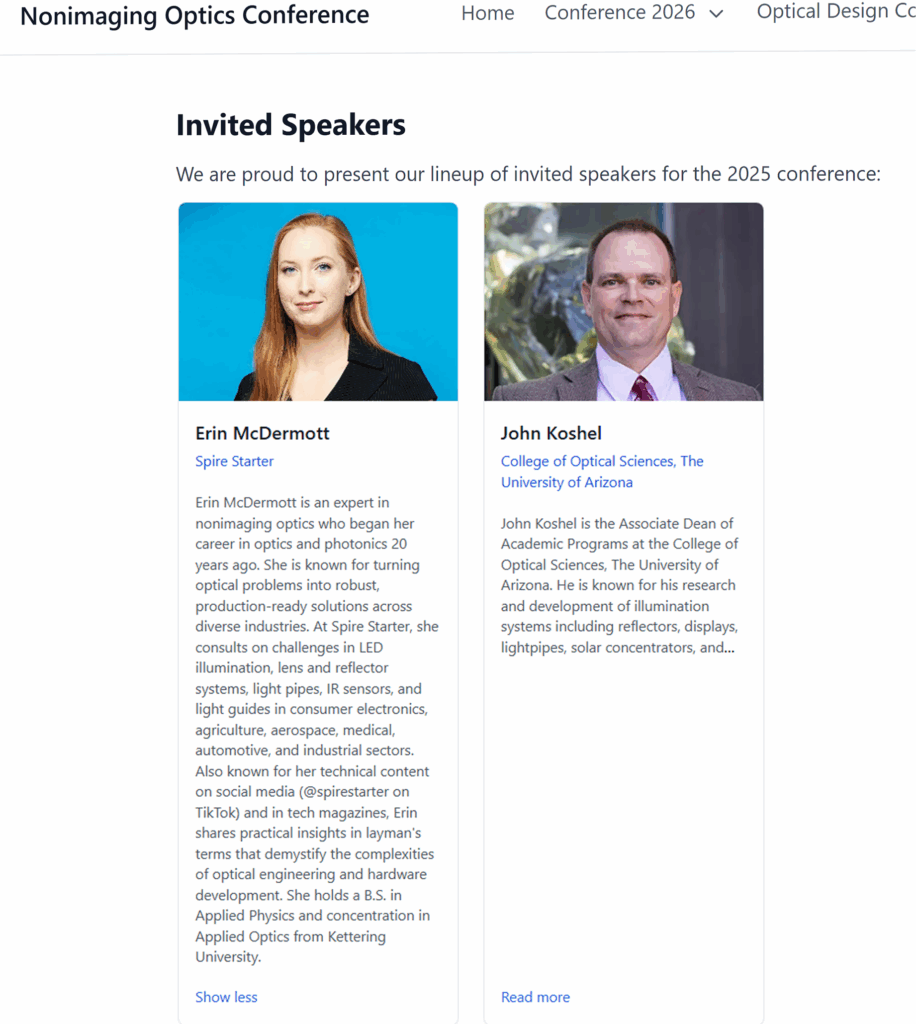
Erin McDermott’s invited talk at SPIE’s Optical Engineering + Applications conference August 2025 is now available online here:
https://doi.org/10.1117/12.3066535


It was part of the Nonimaging Optics Conference program seen here:
https://nonimaging-conference.org/program-2025/


From vast experience working in industry — from large manufacturers to nimble hardware startup teams for more than 20 years — Erin noticed a dangerous disconnect between how optical science is taught and what it’s like to develop optical systems in the real world. Bad assumptions, misunderstandings, and cross-disciplinary communication breakdowns frequently lead to problems, which fresh engineers are not warned about. These can materialize as system failures, delayed development, extra prototyping iterations and failures to deliver that may result in millions of dollars of losses! 

Erin’s talk and accompanying white paper highlight specific examples of these many surprise pitfalls. Moreover, she conveys a new type of thinking necessary to succeed in high volume manufacturing settings. Plugging in numbers into a memorized equation to neatly get the exact correct answer on a multiple choice test is not the solution! The real world is messy. Following a robotic series of steps to engineer “the right way” often leads to disaster, because each individual project is more complicated than an academic rubric can encompass. Different industries, materials, manufacturing methods, and engineering teams can each bring new considerations to how the optical engineer must work to successfully get their 2D simulated optical designs functioning in 3D on the bench.

Theory vs. manufacturing reality: bridging the disconnect in nonimaging optics

ABSTRACT
Nonimaging optics is often presented in academic settings as a clean, linear process: design an optic, add tolerances, and hand it off to be manufactured. Yet, in practice, especially in high-volume manufacturing, the workflow is rarely this smooth and often requires a root cause analysis phase when mysterious errors emerge. This paper presents a series of informal, real-world case studies that illustrate the gap between academic learnings and the types of techniques and mindset necessary to engineer for unpredictable manufacturing environments. Specific examples drawn from Synopsys LightTools, Ansys Speos, and Breault’s ASAP demonstrate how simulation defaults, software limitations, and scatter modeling peculiarities can produce misleading results if applied without comparing to real-world measurements. Additional sections highlight how errors and misunderstandings made by other departments such as manufacturing, mechanical engineering, and even accounting can lead to system failures that an optical engineer will often be tasked with untangling. This paper offers cautionary tales and example solutions to help prime engineers’ thinking on how to prevent failures. Or, when the inevitable happens, to inspire them to let their imaginations soar while brainstorming root causes.

BRDF stands for “Bidirectional Reflectance Distribution Function”. It is a mathematical description of a surface finish, or rather, how light reflects off a surface.

If a surface is pretty evenly rough (or evenly smooth), you can usually get a BRDF measurement of it and create an optical model from that. Every optical simulation software has its own method of importing and formatting these models and usually, you’ll have to have a custom model made for each optical software being used and for each material. If you’re lucky, the model you need might already be in the software’s library. Once you have a working model in your optical software, you can simulate the surface texture in your simulations, which is often super important to get right.